

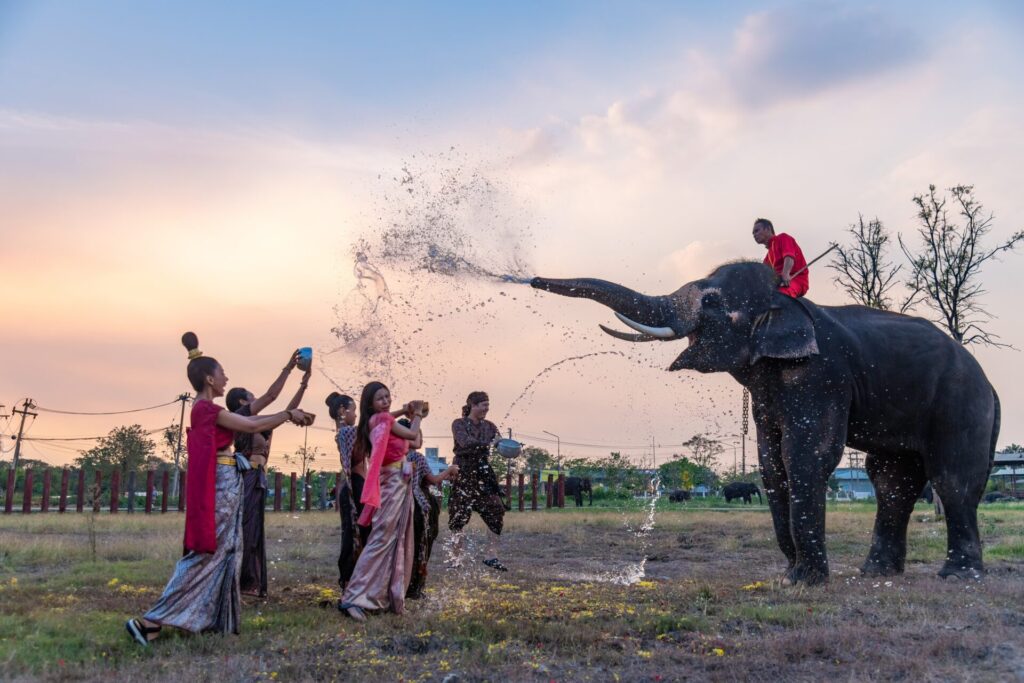
Elephant Conservation Thailand Students
Thailand’s relationship with elephants is long, complicated, and worth understanding. For students who encounter it properly — not from behind a fence on a commercial tour, but through a carefully structured conservation experience — it is one of the most affecting and educationally significant things the Dragon Study programme offers.
The Context Students Need First
The Asian elephant is Thailand’s national symbol. For centuries it was central to Thai royal ceremony, military campaigns, and — most significantly for its modern situation — the commercial logging industry. Elephants were trained over generations by mahout families to work the forests. That knowledge passed from parent to child, mahout to elephant, across hundreds of years.
When Thailand banned commercial logging in 1989, the industry collapsed virtually overnight. Tens of thousands of mahouts and their elephants lost their livelihoods without warning. The result was a conservation crisis that the country is still working through: domesticated elephants that cannot simply be released into the wild, and mahout families whose entire cultural identity and economic livelihood was built around the working relationship with their animals.
World Wildlife Fund’s work across the Greater Mekong region provides important context for the conservation pressures facing Asian elephant populations — both wild and captive — across Southeast Asia.
The Group Leader covers this history with students before the experience begins. Students who understand the situation arrive at the conservation centre as participants in a real story, not spectators at an attraction.
What the Experience Involves
The Dragon Study elephant conservation experience in Thailand is built around activities that benefit the elephants’ welfare and support responsible mahout practice. This means:
- Preparing food for the elephants — cutting and gathering the fruit and vegetation that forms their natural diet
- Feeding the elephants directly in a managed, appropriate setting
- Observing elephant behaviour under guidance from conservation staff and mahouts
- Learning about the health needs and daily care requirements of captive elephants
- Understanding the distinctions between conservation-led tourist experiences and exploitative ones
No riding. No performances. No forced contact that prioritises entertainment over animal welfare.
Students who expected a zoo-style encounter typically adjust their expectations quickly. The experience requires something from them — preparation, attention, physical involvement — and that investment changes the quality of what they take away.
What Happens to Students During the Experience
There is a specific shift that occurs when a student feeds an elephant directly for the first time. It is not easily described but it is consistently observed: something about the scale of the animal, the intelligence in its eyes, and the deliberateness of its movement produces an engagement that has no equivalent in passive observation.
Students who were mildly interested in the itinerary listing become genuinely absorbed. Students who were more focused on the photography opportunity find themselves putting the phone down.
That shift — from observer to participant — is what makes the elephant conservation experience in Thailand educationally valuable in a way that classroom content about conservation never quite replicates. The concept of endangered species becomes, briefly, a specific animal eating fruit from a specific student’s hands.
The Debrief
After the experience, the Group Leader runs a structured debrief. The questions are open: What surprised you? What do you understand now that you didn’t before? What does responsible elephant tourism look like, and how would you recognise the opposite?
These conversations are consistently among the most substantive of the whole programme. Students grapple with the tension between Thailand’s deep cultural connection to elephants and the welfare requirements of animals that can no longer live wild. There is no clean resolution to that tension, and the Group Leader doesn’t manufacture one. The value is in the thinking, not the answer.
There is much more to explore across the Hua Hin region throughout the programme. For a full picture of everything Dragon Study offers, visit the experience page. To book for your group, contact the team here.