

Chao Phraya River Cruise School Trip
Bangkok looks different from the water. The city that can feel relentless at street level becomes coherent from the Chao Phraya — its history visible, its contrasts intelligible, its scale finally comprehensible.
The Chao Phraya River cruise is one of the consistent highlights of the Dragon Study Bangkok school trip, and it earns its place in the itinerary every time.
The River That Built Bangkok
The Chao Phraya has been Bangkok’s central artery since the city was founded in 1782. Trade moved along it for centuries. Royal barges processed down it for state ceremonies. Temples were built to face it. The original Thai name — Mae Nam Chao Phraya, or “great lord of rivers” — reflects its historical importance.
Today the river carries everything from longtail water taxis and tourist cruise boats to cargo barges and converted rice boats. Traditional wooden riverside communities sit directly beside five-star hotels. Ancient temples appear around bends that also reveal construction cranes and office towers.
The Tourism Authority of Thailand identifies the Chao Phraya as one of the country’s most significant heritage corridors. For students who’ve spent the morning inside the Grand Palace complex, stepping onto a boat and looking back at the city from the water provides a perspective that the palace’s walls — magnificent as they are — cannot.
Boarding the Boat
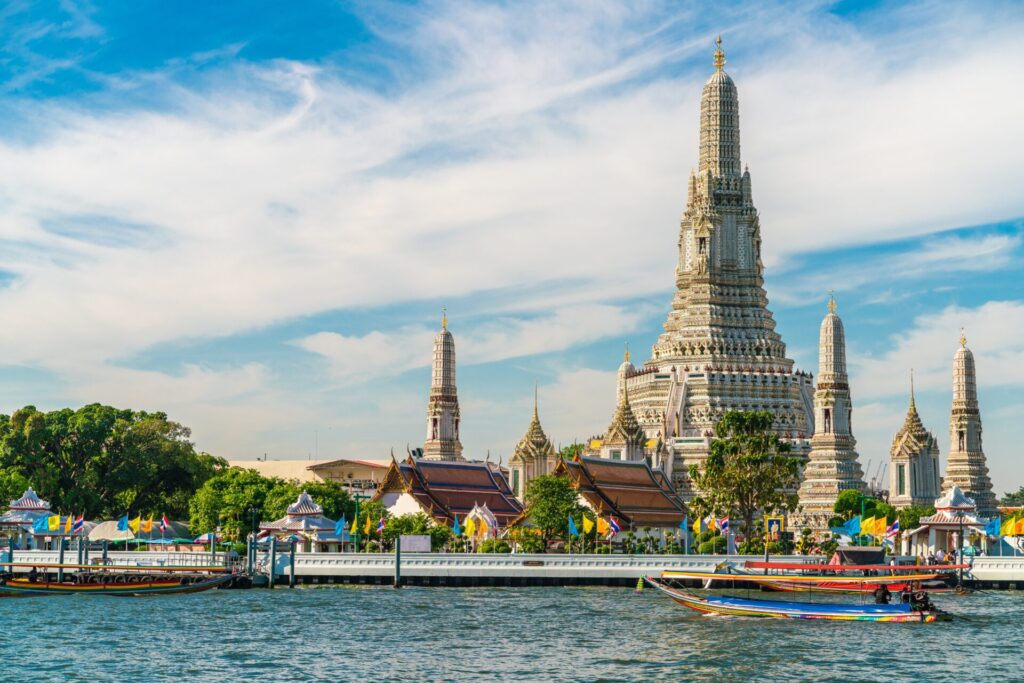
The group typically boards near the Grand Palace landing, after the morning visit to the palace complex and Wat Phra Kaew. The embarkation point itself offers views across the river to Wat Arun — the Temple of Dawn — whose central prang is visible from the water long before the boat reaches it.
Students have just come from one of the most enclosed and visually intense architectural environments in Asia. The transition to an open boat on a wide river, with Bangkok spreading out on both banks, is a genuine shift in scale and mood. The Group Leader uses the transition well — the briefing on what to look for happens on the water, not before boarding.
What Passes on the Banks
The Chao Phraya River cruise on a Dragon Study school trip covers a stretch of Bangkok that contains some of the city’s most significant buildings and most revealing streetscapes.
Students pass Wat Pho — the Temple of the Reclining Buddha — its roofline visible above the riverside wall. They pass the former East Asiatic Company building from the 19th century, now a luxury hotel, with its distinctive European colonial facade sitting improbably among Thai temple rooftops. They pass riverside communities of traditional wooden houses elevated on stilts, occupied by families who have lived on the water for generations.
They also pass the Royal Barge Museum — where Thailand’s elaborately decorated ceremonial vessels are stored between their rare appearances on state occasions. The barges themselves are extraordinary objects, and the Group Leader’s briefing on their significance gives students a context that makes the passing glimpse something more than a passing glimpse.
The Value of Seeing from the Water
There is a particular quality of observation that moving along a river produces. You cannot move faster than the boat. You cannot take a different street to avoid something. The city is presented to you in a single continuous sequence, and you either pay attention or you miss it.
Students on the Chao Phraya River cruise school trip tend to pay attention. The combination of the open boat, the movement, and the density of what passes on both banks creates a quality of engagement that is difficult to produce in other formats.
The Group Leader adds context throughout — pointing out specific buildings, explaining the temple roof styles that distinguish different periods of Thai Buddhist architecture, noting the places where royal barges would have turned before a ceremony. Students who leave the boat knowing what they saw take that knowledge with them in a way that a sightseeing bus never quite produces.
From the River to Lunch
After the cruise, the group disembarks and moves to a riverside restaurant for lunch. The physical rhythm of the Bangkok day trip — the Grand Palace, the river, lunch — leaves students energised at the midpoint, which is exactly the right condition for an afternoon of floating markets and street-level Bangkok.
There is much more to explore in and around Hua Hin when the Bangkok excursions are done. For a full overview of the Dragon Study programme, visit the experience page. Ready to book for your group? Start here.