

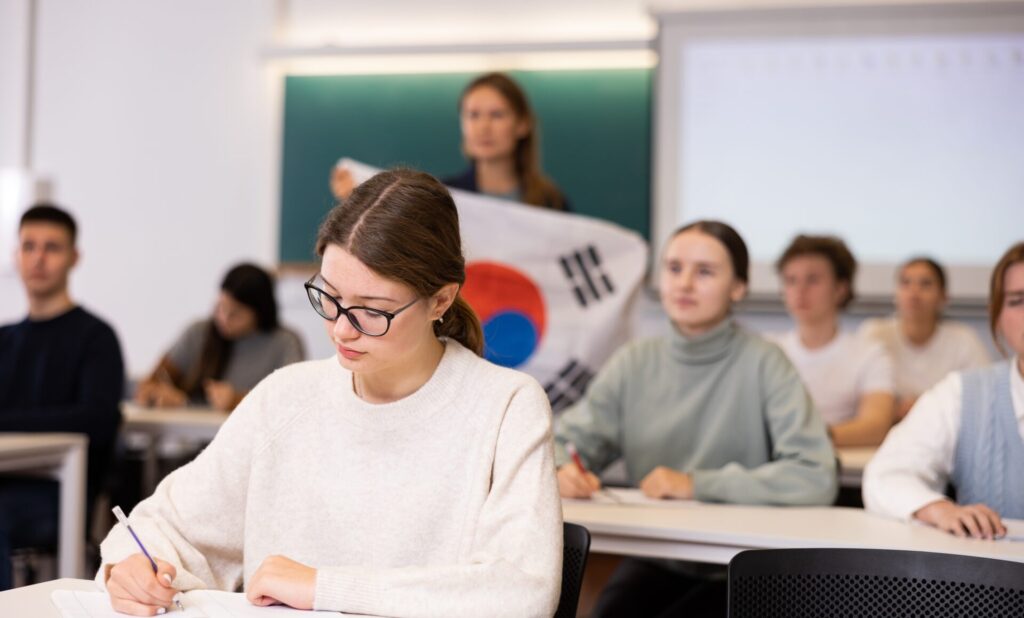
IELTS for Korean Students — Dragon Study Tours Hua Hin
Korea has one of the highest rates of IELTS participation in Asia — driven by competitive university admissions, the prevalence of overseas study programmes, and a culture of academic ambition that produces IELTS candidates who arrive well-prepared, highly motivated, and grammatically strong. Understanding the specific challenges that IELTS Korean students Dragon Study Tours Hua Hin addresses is essential for tour organisers planning IELTS preparation programmes for Korean groups — because the challenges Korean students face in IELTS are specific, well-documented, and very directly addressable through residential English immersion.
The Speaking Confidence Gap
The most significant IELTS challenge for Korean students is not knowledge — it is spoken confidence. Korean students typically arrive at Dragon Study Tours with excellent formal grammar, strong passive vocabulary, well-developed reading skills, and a disciplined approach to study that produces measurable improvement quickly. They frequently arrive with speaking skills that significantly underperform relative to their written English ability — not because their spoken English is structurally weak, but because the cultural and educational context of English use in Korea does not provide the spontaneous, natural, sustained speaking practice that IELTS Part Two and Part Three specifically demand.
IELTS Part Two requires students to speak for one to two uninterrupted minutes on a topic revealed sixty seconds earlier. IELTS Part Three requires sustained abstract discussion with an examiner on complex topics — expressing opinions, speculating about future trends, comparing perspectives. These demands require the spontaneous spoken English production that Korean classroom English education, focused primarily on receptive and written skills, does not typically build.
For IELTS Korean students Dragon Study Tours Hua Hin addresses this directly through residential immersion. Students who spend thirteen or twenty nights in an environment where English is the only available language — where every meal, every excursion, and every evening requires real spoken English communication — develop the spontaneous speaking confidence that Korean classroom English cannot provide. The transformation is measurable across the programme. Students who arrive hesitant in spoken English typically leave significantly more fluent and confident by the final session.
IDP’s article on how to perform at your best in IELTS Speaking Part 3 is particularly relevant for Korean students whose Part Three abstract discussion scores are below their target.
Pronunciation — What Actually Matters
Korean phonology includes sounds that do not exist in English and omits consonant clusters and vowel distinctions that English requires. The distinction between l and r, the vowel contrast in words like “ship” and “sheep,” and the final consonant clusters in English words like “tasks” or “months” are consistent areas of challenge for Korean speakers. IELTS examiners assess communication effectiveness, not accent — so pronunciation that does not affect intelligibility does not affect band score. But pronunciation habits that affect how clearly and naturally spoken English is received do affect the Band Descriptors at Band 6 and above.
Dragon Study Tours’ speaking and grammar block — 10:10 to 10:50 — addresses pronunciation specifically for IELTS Korean students Dragon Study Tours Hua Hin identifies as needing it, with daily native teacher modelling and individual feedback.
Writing — Strength to Build On
Korean students typically have stronger writing foundations than their speaking foundations — which means writing development at Dragon Study Tours for Korean groups often focuses on elevating existing competence from Band 6 to Band 7 rather than building from a lower base. The specific writing development focus for Korean students is typically task response — ensuring the essay directly and completely answers the specific question asked — and cohesive device use, which Korean academic writing conventions do not always prioritise in the same way IELTS requires.
For IELTS registration in Hua Hin, visit ILC Training and the ILC IELTS preparation page. Test registration in Thailand is through British Council Thailand.
See the academic programme, study tours, The Palm Residence, and Dragon Study Tours blog.
📲 WhatsApp: +66 63 615 6978 🌐 www.dragonstudy.org