

Hua Hin Mangrove Forest Boat Tour: 5 Best Highlights
There are excursions that students enjoy in the moment and forget within a week. And then there are the ones they still talk about months later — the ones that lodged somewhere specific, for reasons they find hard to explain.
The Hua Hin mangrove forest boat tour is the second kind. Not because it’s dramatic or fast-paced, but because it’s genuinely unlike anything most students have experienced before.
Where the Mangroves Are
Hua Hin sits on the Gulf of Thailand in Prachuap Khiri Khan province — a stretch of coastline that has remained, by Thai standards, remarkably undeveloped. Inland from the shore, a network of tidal waterways and estuaries cuts through the coastal plain, and along their banks, the mangrove forests grow.
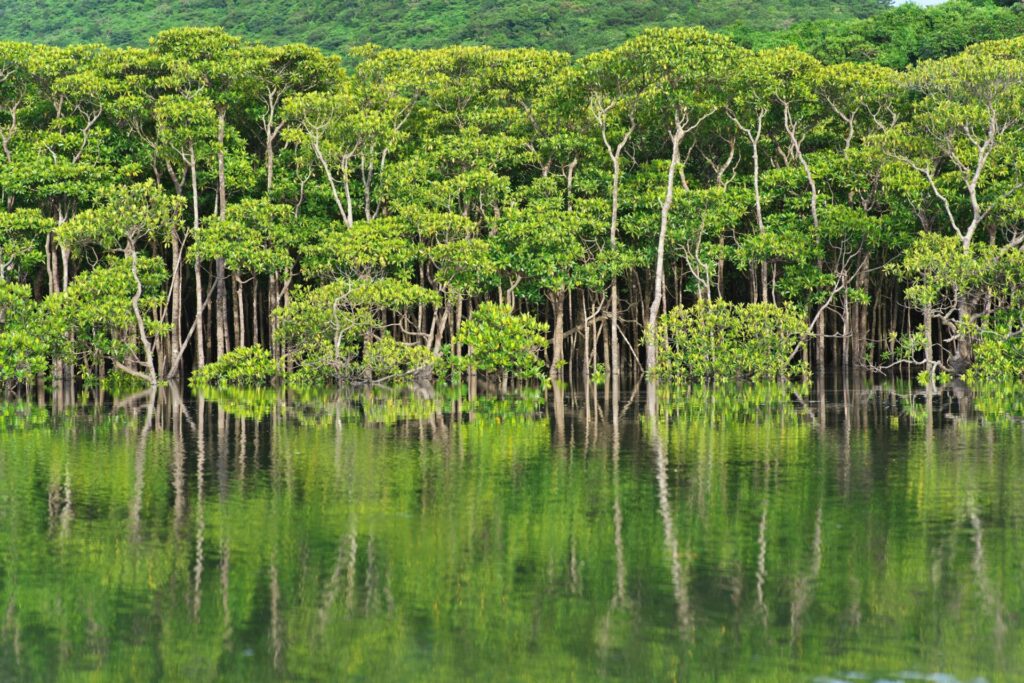
These are not the neat, park-like green spaces students might associate with nature excursions back home. Mangrove forests are dense, layered, and alive in an almost unsettling way. The root systems of the trees arch into the water in complex tangles. The canopy closes overhead as you move deeper into the channels. The light changes. The noise of the town disappears entirely.
The Tourism Authority of Thailand identifies mangrove conservation as one of the country’s environmental priorities, and the forests accessible from Hua Hin are among the best-preserved on the Gulf coast. Getting onto the water and inside them is something very few visitors to Thailand ever do.
Getting to the Embarkation Point
The Dragon Study group travels from The Palm Residence to the embarkation point together. Before boarding, the Group Leader briefs students on what they’re about to see — what mangrove forests are ecologically, why they matter, what the tidal system looks like from above, and what to look out for on the water.
This preparation makes a difference. Students who arrive at an experience already curious engage with it differently from those who arrive cold. By the time the first boat pushes off, students are looking — properly looking — not just sitting.
The Longtail Boat
The vessels used on the Hua Hin mangrove forest boat tour are traditional Thai longtail boats: long, low, narrow wooden craft powered by converted automotive engines mounted on a swivel at the stern. They are nothing like a ferry, nothing like a canal boat, and nothing like anything most students will have been on before.
The engine is loud when it opens up. The boat sits close to the water. At speed, the bow lifts slightly and the shoreline blurs. Students who were uncertain about the experience at the briefing are usually grinning before the first bend in the channel.
Inside the Forest
Once the boats turn off the main waterway and into the narrower channels of the mangrove forest, everything changes. The engine drops to an idle. The canopy closes in on both sides. The temperature drops a degree or two in the shade.
The guide — a local boatman who knows these waterways the way most people know their own street — navigates the channels from memory. The forest offers up its inhabitants steadily, to those paying attention.
Kingfishers sit on branches at arm’s length from the boat. Mudskippers — extraordinary fish that breathe air and move across mud on modified pectoral fins — watch from the banks. Herons stand motionless in the shallows. In the canopy above, hornbills call.
Students who have their phones out for the first ten minutes gradually put them away. There is something about the quality of attention that a mangrove forest demands that makes documentation feel beside the point.
What Students Learn
The Group Leader draws the ecology together after the tour — how mangrove forests protect coastlines from erosion and storm surge, how their root systems act as nurseries for marine life, how the deforestation of coastal mangroves across Southeast Asia has accelerated flooding in communities that once relied on them.
These are not abstract environmental facts when you’ve just been inside the system they describe. Students who’ve seen a functioning mangrove forest from a boat carry that understanding differently from students who’ve read about it. The experience provides the image. The debrief provides the meaning. Together, they produce something more durable than either would alone.
The Return
The boats come back out into the main waterway and the group returns to shore. Students who’ve been on the water together for an hour and a half have, almost without exception, produced a set of shared reference points — the kingfisher that landed too close, the channel that seemed to be getting narrower, the moment the engine cut out entirely for thirty seconds.
These small shared moments are the material from which group dynamics deepen. By the time the group boards the transport back to Hua Hin, the bonds formed on the Hua Hin mangrove forest boat tour are slightly different from the ones that existed before it.
That’s a consistent pattern in Dragon Study excursion design. The activity creates shared experience. The shared experience creates connection. The connection is what students remember longest — not the kingfisher itself, but who was sitting next to them when it appeared.
There’s plenty more to discover in Hua Hin and the surrounding region. For a full picture of what the Dragon Study programme offers, visit the experience page. Ready to bring your group? Book here.