

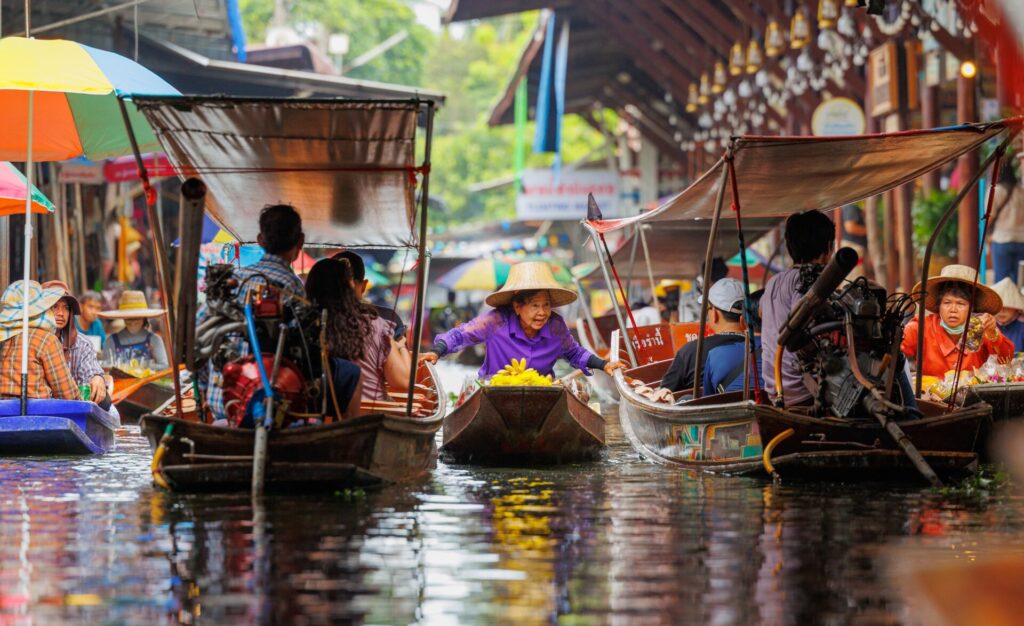
Hua Hin Floating Market
Some excursions take students an hour from their base. Some take three. And some are right on the doorstep of Hua Hin — close in distance, rich in experience, and no less memorable for the brevity of the journey.
The Hua Hin floating market is one of Dragon Study’s most consistently enjoyed local excursions, and it introduces students to a form of Thai culture that has no real equivalent anywhere else.
What a Floating Market Is
Thailand’s floating markets grew from the country’s original transport infrastructure. Before roads connected its towns and villages, canals were the highways — and vendors who moved goods along the waterways sold directly from their boats. The markets that emerged from that trade became, in many regions, the social and commercial centre of everyday life.
The Hua Hin floating market sits along the canal system accessible from the town. It is a genuine working market — real vendors, real transactions, real Thai people going about the kind of commerce that has happened on these waterways for generations. Students are not visiting a heritage recreation. They are stepping into something that still functions in the way it always did.
The Journey There
The Dragon Study group travels together from The Palm Residence to the market, arriving in the morning when activity is at its peak. The Group Leader briefs students before departure on what the market sells, how Thai market interactions typically work, the etiquette of negotiation, and what to look out for in terms of both the best food stalls and the most interesting vendors.
Students who arrive at the Hua Hin floating market already curious about specific things tend to have a richer experience than those who arrive without any orientation. Dragon Study’s Group Leaders know the market well, and their briefings reflect that.
A Sensory Experience
The floating market is, above all, a sensory environment. Wooden boats covered in banana leaves and loaded with tropical fruit sit alongside stalls selling coconut ice cream made to order, pad thai cooked on portable woks in under two minutes, grilled satay with peanut sauce, fresh papaya salad, and mango sticky rice.
The smell of charcoal, coconut milk, and lemongrass. The sound of vendors calling across the water. The colours of the fruit stalls against the brown of the canal.
Tourism Thailand consistently highlights Thailand’s market culture as one of the country’s most distinctive and authentic experiences for visitors. At the Hua Hin floating market, on a Dragon Study student trip, students are not observing that culture from a respectful distance. They are inside it.
Trying the Food
Students who’ve been cautious about Thai food at The Palm Residence tend to relax at the floating market. There is something about the visible preparation — watching the wok, choosing the protein, receiving the finished dish in thirty seconds — that makes unfamiliar food less intimidating than it is when it arrives on a plate.
Most students try something they wouldn’t have chosen at a restaurant menu. Many discover a favourite dish. The mango sticky rice, in particular, has a conversion rate among Dragon Study students that the Group Leaders have long since stopped being surprised by.
The Art of Thai Negotiation
The floating market is one of the few places in the Dragon Study excursion programme where students have genuine, unmediated interaction with Thai vendors. Thai market culture has its own norms around pricing — respectful, often good-humoured, and generally concluded with both parties satisfied and a degree of theatrical goodwill.
Students who attempt a transaction — even imperfectly, even with a translation app and a lot of hand gestures — almost always leave it feeling something specific. A small accomplishment. Evidence that they can operate in a genuinely foreign commercial environment.
These small moments compound across a programme. Each one adds to a student’s confidence in unfamiliar situations — which is, ultimately, one of the most durable things a residential trip to Thailand can produce.
Structured Freedom
The Group Leader gives students structured free time within clear boundaries. The market is navigable, the Group Leader is visible throughout, and students have enough space to explore independently without the structure tipping into chaos.
This balance — freedom within a framework — is characteristic of how Dragon Study manages the parts of the programme where the learning happens through experience rather than through direct instruction. The floating market is one of those parts.
There’s much more to discover in and around Hua Hin across the full programme. For more on everything Dragon Study offers, visit the experience page. Ready to bring your group? Book here.