

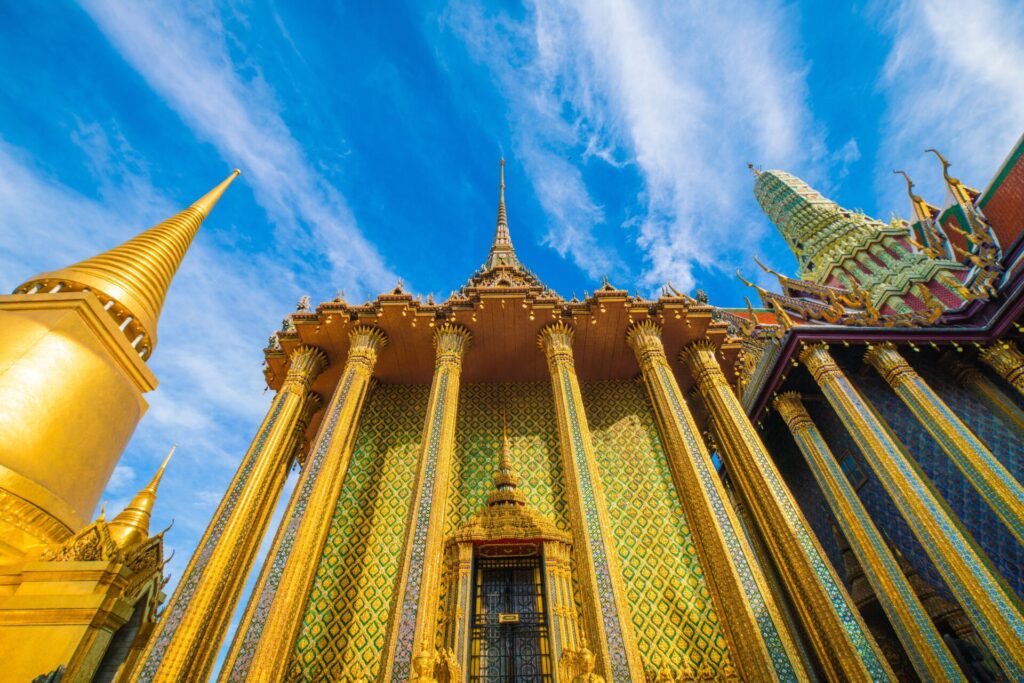
Bangkok is one of those cities that resists easy description. It is enormous, layered, historically extraordinary, and entirely unlike anything most students have encountered before. A day there — properly planned, professionally guided, and built around the specific needs of a student group — is the kind of experience that reframes the rest of the programme. It raises the bar for what a day can be.
Dragon Study’s Bangkok day trip for students is one of the most anticipated excursions on the programme. Here is what it actually looks like, from the 5:00 AM departure through to the return journey south.
Why the Start Time Matters
The group leaves The Palm Residence at 5:00 AM. Students hear this at the evening briefing and the response is predictable. By the time they’re on the coach and Bangkok is appearing on the horizon in the early morning light, nobody is complaining.
The early start is not arbitrary. Bangkok in the late morning is hot, crowded, and logistically complex. Bangkok at 8:30 AM — when the Grand Palace is beginning to fill but hasn’t yet reached full capacity — is a different place entirely. Dragon Study’s Bangkok day trip for students is designed to use the best hours of the city, which means starting when others are still in bed.
The three-hour drive north is used productively. The Group Leader briefs the whole group on the day’s itinerary — what each site is, why it matters historically and culturally, what to look out for, and how the different parts of the day connect. Students who arrive at the Grand Palace already oriented engage with it in a completely different way from those who walk in cold.
The Grand Palace and Wat Phra Kaew
The Grand Palace is the anchor of the day. The complex covers more than 218,000 square metres — an entire royal city of ceremonial halls, golden chedis, ornate gateways, and meticulously maintained architectural detail. First-time visitors consistently underestimate its scale before they arrive, and consistently find it overwhelming in the best possible way once they’re inside.
At the heart of the complex sits Wat Phra Kaew — the Temple of the Emerald Buddha — housing Thailand’s most sacred religious image. The Emerald Buddha is carved from a single piece of jade and dressed in seasonal gold robes that the Thai King changes personally, three times a year, to mark the changing of the seasons. The ritual has continued without interruption for over two centuries.
Dragon Study uses a licensed on-site guide at the Grand Palace, which means students receive specific, accurate historical and cultural context as they move through the complex. The difference between walking through the Grand Palace with a briefed guide and walking through it with a map and a time limit is not a small one. Students who understand what they’re looking at engage with it as a living cultural site rather than an impressive backdrop for photographs.
The Chao Phraya River Cruise
After the Grand Palace, the group boards a boat for a cruise along the Chao Phraya — the river that has defined Bangkok’s geography, commerce, and royal ceremonies since the city was founded in 1782. Temple spires rise above the banks. Traditional wooden riverside houses sit against the glass towers of modern Bangkok. The contrast is total and entirely characteristic of the city.
From the water, Bangkok becomes coherent in a way that its streets don’t always allow. The density and noise of the Grand Palace district gives way to an open, moving perspective that lets students see the city as a whole — its scale, its layers, its relationship to the water that made it possible. Many students find the Chao Phraya cruise the moment the city stops being overwhelming and starts being something they want to understand better.
The Group Leader continues briefing throughout — pointing out specific buildings, explaining the significance of the riverside temples, describing the royal barge ceremonies that still take place on this stretch of water on state occasions.
Lunch
After the cruise, the group eats at a riverside Thai restaurant. Good food, properly prepared, with enough variety that students at different stages of their relationship with Thai cuisine can all find something. By this point in the Bangkok day trip for students, the morning has produced a significant amount of new information and experience. Lunch is the chance to decompress, share observations, and arrive at the afternoon with energy rather than exhaustion.
The Floating Market
The afternoon takes the group to a traditional Thai floating market — a network of canal-side vendors selling fresh produce, cooked food, and goods from boats moored along the waterways. Floating markets in Thailand are not tourist recreations. They are functioning commercial environments that have operated on the same waterways, in the same way, for generations.
Students are given structured free time within clear boundaries. The Group Leader is present and visible throughout, but the floating market is deliberately designed as an immersive experience rather than a guided tour. Students navigate it independently, try the street food, and experience the gentle art of Thai market negotiation — a cultural interaction that most of them find both challenging and genuinely enjoyable.
For many students, the floating market is the moment on the Bangkok day trip where Thailand stops being something they’re observing and becomes something they’re inside.
MBK Shopping Centre
The day ends at MBK Shopping Centre — Bangkok’s famous multi-level market mall, where several thousand vendors occupy eight floors of food, fashion, electronics, souvenirs, and street food. It is the complete antithesis of the Grand Palace, and that contrast is entirely intentional.
Both environments are Bangkok. One represents its royal and religious past. The other represents its commercial, urban present. Students who’ve moved through both in a single day carry away a picture of the city that no single site could produce — one that has depth, range, and the kind of productive contradiction that makes a place genuinely interesting.
The Return
The group departs Bangkok at around 6:00 PM and arrives back in Hua Hin around 9:30 PM. Students are tired in the way that comes from a full day of genuine engagement — full of impressions, full of observations, still talking.
The Bangkok day trip for students consistently produces the most conversation of any day on the programme. Students who’ve been relatively quiet during the week tend to have something to say after Bangkok. The city does that to people.
There is a great deal to explore in and around Hua Hin across the rest of the programme. For everything the Dragon Study experience offers, visit the programme page. To book for your group, start here.