

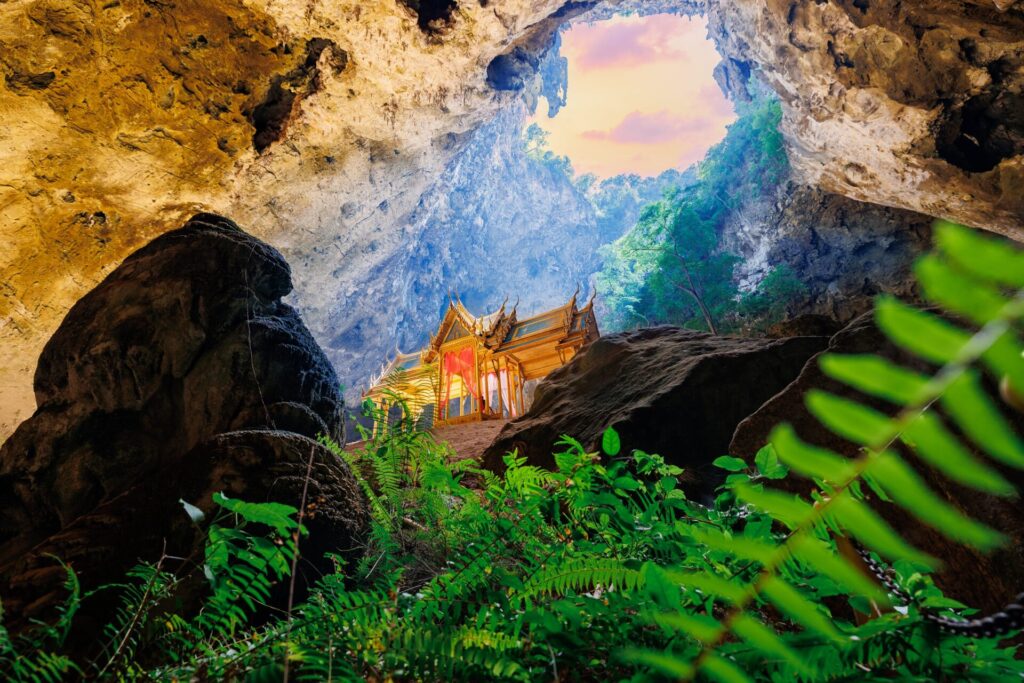
Phraya Nakhon Cave Thailand
Ask any group of Dragon Study alumni what the highlight of their programme was and the answers spread across the week — the Bangkok day trip, the mangrove forest, the first morning in Hua Hin. Ask them what they’d go back for first and most of them say the same thing.
Phraya Nakhon Cave. Every time.
Where It Is
Phraya Nakhon Cave sits inside Khao Sam Roi Yot National Park — a protected coastal park about 60 kilometres south of Hua Hin in Prachuap Khiri Khan province. The park takes its name from the limestone karst formations that rise sharply from the flat coastal wetlands: khao sam roi yot means “mountain of three hundred peaks.” Even the drive through the park to the embarkation point is worth stopping for.
The Tourism Authority of Thailand lists Phraya Nakhon Cave Thailand as one of the country’s most remarkable natural and cultural sites. That’s not a routine description — it genuinely is.
Getting There
The excursion begins early. The Dragon Study group leaves Hua Hin by private transport before the heat builds and arrives at the coastal village of Bang Pu, where traditional wooden fishing boats carry visitors across the bay to the beach at the base of the cliff face.
The crossing takes about twenty minutes. The cliff rises directly from the water. Students who thought they were going on a cave visit begin to understand, from the boat, that they are going on something considerably more involved than that.
The Hike Up
From the beach, a stone path climbs steeply up the cliff through dense jungle vegetation. The ascent involves approximately 430 steps — not long, but unrelenting in the heat. Trees provide partial shade. The sound of the sea disappears. The forest closes in.
Students who are fit find it energising. Students who are less so find it demanding but manageable. The Group Leader sets a pace that keeps the group together, and nobody goes ahead or falls behind alone. By the time the path levels out near the summit, every student in the group has done something physically effortful — together.
That shared effort matters. The achievement of arriving at the top belongs to the group, not to the fastest climbers.
Inside Phraya Nakhon Cave
The cave itself is a collapsed karst cavern — a vast underground chamber whose roof has partially fallen in, leaving a massive hole through which sunlight pours down in a single dramatic beam.
At the bottom of that beam, on the floor of the cave, sits the Khuha Kharuehat pavilion — a royal sala built for King Rama V in 1890. It is a delicate, intricately decorated Thai pavilion sitting in the middle of a jungle cave, lit from above by natural light through limestone, surrounded by vegetation growing in the shaft of sun.
There is nothing else quite like it anywhere. Students who have just climbed a cliff in tropical heat emerge at the top of the descent path, look down into the cave, and stop.
That moment — the intake of breath, the pause, the reaching for a phone that somehow feels inadequate — is one of the constants of the Dragon Study programme. It happens every time. It cannot be engineered or manufactured. The cave simply produces it.
History and Cultural Context
The Group Leader briefs students on the site before departure and adds context at the cave itself. The Khuha Kharuehat pavilion has been visited by multiple Thai monarchs. The site appeared on the 500-baht banknote. It holds genuine significance in Thai royal and religious tradition.
Students who understand what they’re looking at engage with it far more deeply than those who see it cold. A pavilion in a cave is interesting. A royal sala built for a king who came here by boat in 1890, and which has remained in its original condition ever since, surrounded by the same jungle and the same shaft of light — that is extraordinary.
The Return
The descent is faster than the climb. Students pick their way back down the path, board the fishing boats, and cross back to the village. By the time the group boards the transport for the return to Hua Hin, the day has produced something specific.
Not just a good memory — although it is that. But a shared experience that required something from every student in the group. The hike asked for effort. The cave asked for presence. Together, they produced the kind of day that changes the texture of the programme and deepens the bonds within the group.
There is much more to discover across the Hua Hin region. For a full overview of the Dragon Study excursion programme, visit the experience page. Ready to book for your group? Start here.