

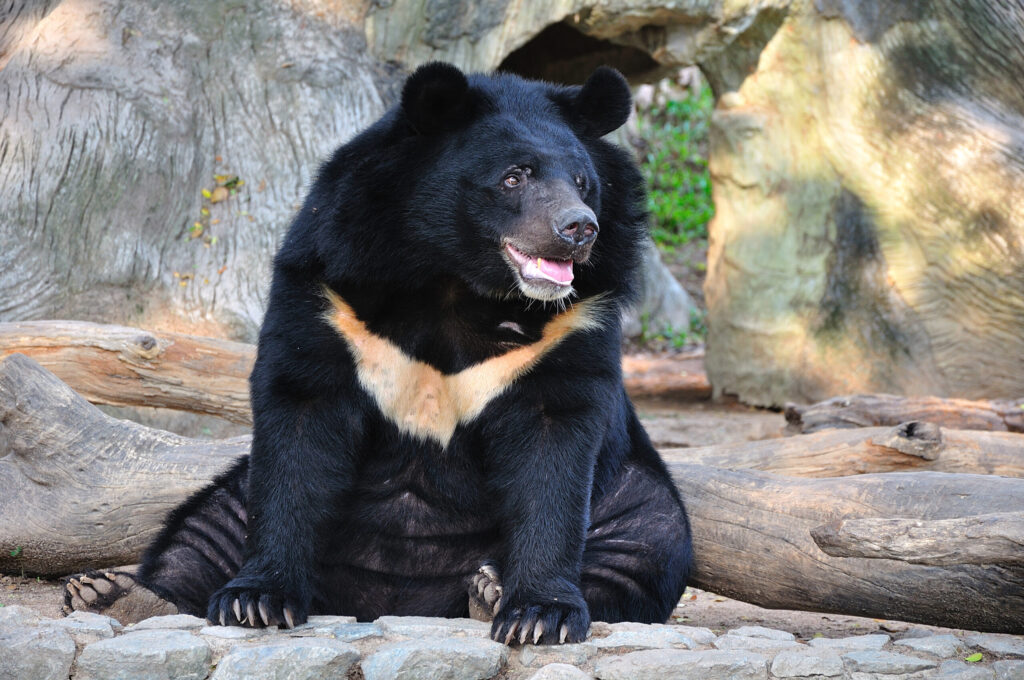
Moon bears Thailand are one of the most powerful conservation encounters on the Dragon Study Tours Elephant Conservation Experience programme. At Wildlife Friends Foundation Thailand near Phetchaburi, closed groups aged 13 to 17 encounter Asiatic black bears — moon bears Thailand — rescued from some of the most appalling conditions in the wildlife trade. Running all year round, the WFFT full day gives participants a conservation education that goes far beyond anything a classroom could deliver.
What Moon Bears Thailand Are
Moon bears Thailand — Asiatic black bears — are medium-sized bears found across a wide range of Asia, from Pakistan and India through Southeast Asia to Japan and Russia. They are named for the distinctive crescent-shaped patch of cream fur on their chest, which resembles a moon. In Thailand they are a protected species, but that protection has not been enough to stop the illegal trade that has brought so many of the moon bears Thailand at WFFT to the sanctuary.
Moon bears are listed as vulnerable on the IUCN Red List. Their main threats are deforestation and habitat loss — Thailand has lost the majority of its forest cover over the past century — and the bear bile trade, one of the cruellest industries in the world.
The Bear Bile Trade and the Moon Bears Thailand at WFFT
The bear bile trade is the reason that many of the moon bears Thailand at WFFT are in Phetchaburi rather than in the forests of northern Thailand. Bear bile is used in traditional Asian medicine and is extracted from living bears — a process that involves keeping animals in tiny cages, often unable to stand or turn around, with catheters inserted into their gall bladders. Moon bears kept in bile farms rarely live beyond ten years, compared to a natural lifespan of 25 to 30 years in the wild.
WFFT currently cares for more than 30 sun and moon bears. Among them are animals like Ginny, an Asiatic black bear who spent years in a small concrete cage at the Phuket Zoo before being rescued and transferred to WFFT in 2022, and bears rescued directly from the illegal trade. When participants spend their full day at WFFT, they learn these individual stories — and understand the bear bile trade not as an abstraction, but as the lived experience of specific animals they have spent the day working alongside.
What Participants Do With the Moon Bears Thailand
During the WFFT full day, participants assist with feeding rounds for the moon bears Thailand — a diet that includes fruits, vegetables, insects, and protein sources that mimic as closely as possible what these bears would eat in the wild. They support habitat enrichment activities designed to encourage the natural foraging and climbing behaviours that bile farm bears have often lost entirely. And they receive a guided education session on the bear bile trade, wildlife trafficking, and what WFFT is doing to address it.
Safety at the Moon Bears Thailand WFFT Session
All aspects of the WFFT full day, including the moon bears Thailand encounters, are managed within the full Dragon Study Tours safety framework. WFFT follows a strict hands-off protocol. Transport is by private air-conditioned coach. The Palm Residence provides 24/7 supervision and safeguarding procedures aligned to British Council accreditation standards.
The programme runs all year round for closed groups. Visit our 50 things to do in Hua Hin guide, request a quote, make a booking, or read our FAQ.