

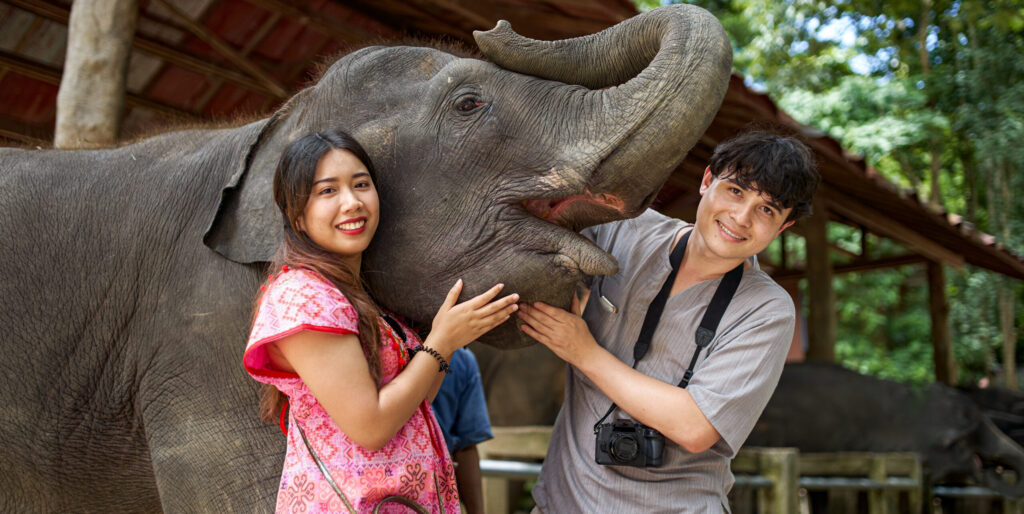
Elephant conservation education Thailand is at the heart of everything the Dragon Study Tours Elephant Conservation Experience delivers. Closed groups aged 13 to 17 do not simply visit the Hutsadin Elephant Foundation and Wildlife Friends Foundation Thailand — they work there, session after session, accumulating an elephant conservation education Thailand that is built on direct experience rather than observation. Running all year round, this is the most comprehensive elephant conservation education Thailand available to teen groups anywhere in the country.
What Elephant Conservation Education Thailand Actually Involves
Elephant conservation education Thailand on the Dragon Study Tours programme is not delivered through lectures and worksheets. It is delivered through daily work alongside the people who are doing the actual conservation — the mahouts at Hutsadin, the care staff at WFFT, the guides who lead the Kui Buri wildlife safari.
The elephantconservation.org resource on Asian elephants identifies the key components of effective elephant conservation education Thailand: understanding the species’ biology and behaviour, understanding the historical and cultural context of human-elephant relationships in Thailand, understanding the specific threats facing both wild and captive populations, and understanding what effective conservation responses look like in practice.
The Dragon Study Tours programme addresses all four of these components — not as separate modules, but as an integrated, immersive experience that unfolds across 14 days.
The Biology and Behaviour Component of Elephant Conservation Education Thailand
The biology and behaviour component of elephant conservation education Thailand on the Dragon Study Tours programme is delivered through the seven morning sessions at Hutsadin. Participants learn about elephant anatomy — the significance of the trunk, the tusks, the remarkable skin — and about the complex social and emotional lives of elephants that make them so challenging and so rewarding to care for.
The World Wildlife Fund documents the extraordinary cognitive abilities of Asian elephants — their capacity for problem-solving, self-recognition, empathy, and long-term memory. Participants working alongside the mahouts at Hutsadin encounter these abilities directly, in the behaviour of individual animals they have come to know across seven sessions.
The Historical and Cultural Component of Elephant Conservation Education Thailand
The historical and cultural component of elephant conservation education Thailand is delivered through the wider programme — the excursions to Maruekhathayawan Palace, the visits to local temples, the evening meals in Hua Hin restaurants that have been feeding the town for generations. The elephant has been central to Thai culture for centuries — in warfare, in ceremony, in logging, in the national identity. Understanding that history is essential to understanding the current conservation challenge.
The Elephant Conservation Network documents the cultural dimensions of elephant conservation education Thailand in detail — the complex relationships between mahouts, elephant owners, and conservation organisations that shape what is possible in the field.
Safety in the Elephant Conservation Education Thailand Programme
All aspects of the elephant conservation education Thailand programme are managed within the full Dragon Study Tours safety framework. Transport is by private air-conditioned coach throughout. The Palm Residence provides 24/7 supervision and safeguarding procedures aligned to British Council accreditation standards.
The programme runs all year round for closed groups. Visit our 50 things to do in Hua Hin guide, request a quote, make a booking, or read our FAQ.