

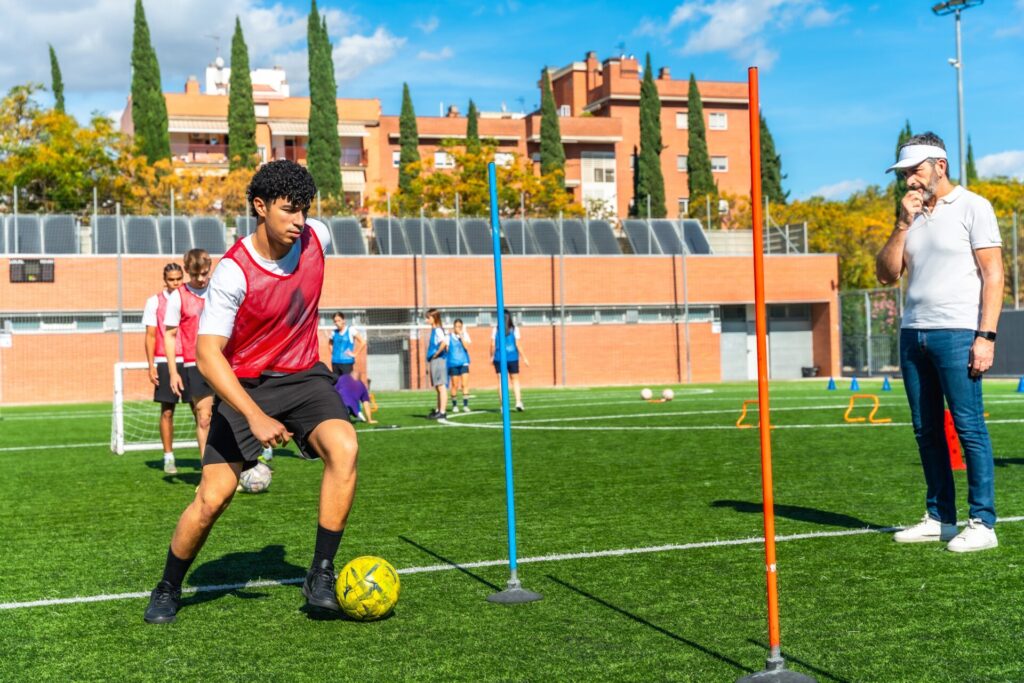
Language learning works best when the learner has a reason to communicate. Not a classroom reason — a real one. A reason rooted in something the learner already cares about, already understands at an intuitive level, already has strong opinions about. For millions of students aged seven to seventeen across the Gulf, Southeast Asia, and East Asia, that reason is football. And the evidence that football teaches English communication in Thailand — and everywhere else — is compelling, well-researched, and immediately visible in the Dragon Study Tours classroom.
At Dragon Study Tours in Hua Hin, both the Premier Skills Football English programme and the Hatriqa Football English methodology use football as the primary context for English language development. Here are five powerful ways that football teaches English communication in Thailand, and why this approach produces results that a standard English classroom cannot match.
1. Football Creates Intrinsic Motivation
A student who does not particularly care about English but cares deeply about football arrives at the Dragon Study Tours classroom with something that is genuinely difficult to manufacture in a standard English lesson — intrinsic motivation. They want to understand what the commentator said. They want to know what the manager meant by that instruction. They want to be able to describe a goal in English. They want to read a match report and understand every word.
Cambridge Assessment English research on motivation in language learning consistently identifies intrinsic motivation — learning driven by personal interest rather than external requirement — as the strongest predictor of progress in English language acquisition. The fact that football teaches English communication in Thailand so effectively is not accidental. It is motivational design.
2. Football Generates Rich, Transferable Vocabulary
Football generates specific, varied vocabulary that transfers directly to general English use. Tactics, positions, instructions, encouragement, narrative, analysis — the language of football is the language of communication. Students who learn to describe a match are learning to narrate events. Students who conduct a press conference in English are learning formal, confident spoken English. Students who write a player profile are learning descriptive and evaluative writing. Students who argue for a formation in a team talk are learning persuasion.
The vocabulary of football is not a specialised subset of English that stays on the pitch. It is a direct entry point into the registers of communication that matter in academic and professional life. This is why football teaches English communication in Thailand with measurable, transferable results.
3. Football Lowers the Anxiety of Speaking
One of the most significant barriers to spoken English development in young learners is anxiety — the social cost of making a mistake in front of peers. Football changes the emotional context of speaking. A student who says something grammatically imperfect about a match they watched at the weekend is not failing at English — they are sharing something they are passionate about. The frame of the conversation removes the anxiety of the linguistic performance. Native English teachers at Dragon Study Tours use this dynamic deliberately — drawing students into football discussions and gradually increasing the linguistic demand without the student noticing the transition.
4. Football Gives Grammar a Real Purpose
Grammar taught in isolation — as a system of rules to be memorised — rarely produces communicative competence. Grammar encountered as a need — as a tool required to express something the student genuinely wants to say — produces understanding that sticks. When a student wants to describe what happened in a match, they need the past tense. When they want to predict next week’s result, they need the future. When they want to argue why their team deserved to win, they need conditional structures. Football teaches English communication in Thailand by making grammar purposeful rather than procedural.
5. Football Makes Every Skill Meaningful
Listening, reading, writing, speaking — all four English skills are present in the football world, and all four are used in every Dragon Study Tours morning session. Students listen to commentary and coaching. They read match reports and tactical analyses. They write player profiles and press conference responses. They speak in role-plays, debates, and collaborative projects. The British Council framework that underpins the Dragon Study Tours programme recognises this integrated skills approach as the most effective route to communicative competence.
The Structure at Dragon Study Tours
Before arrival, the tour organiser receives a complete study plan — lesson by lesson, objective by objective — so there are no surprises. The morning runs in three blocks. Block One covers listening and reading with authentic football materials. Block Two covers speaking, grammar, and communication delivered by native English teachers in classes of maximum twelve students. Block Three is collaborative project work — press conferences, match reports, player profiles — where everything from Blocks One and Two is put to real use.
Football teaches English communication in Thailand at Dragon Study Tours across a full residential programme, and the results are visible across the full programme duration. Our full academic programme covers every available course. For a full picture of what students experience beyond the classroom, the 50 Things to Do in Hua Hin covers every excursion. To plan your group, visit the booking page or request a quote. You can also explore why native English teachers make the difference and why maximum 12 students per class matters for more detail on the Dragon Study Tours approach.